The appropriate CNC stone fabrication tolerance depends on the stone material, machine capability, tool condition, design complexity, edge profile, and installation requirements. For many precision stone fabrication projects, a practical dimensional tolerance may be around ±1 mm to ±2 mm, while more critical features may require tighter control after considering the machine, tooling, material, and measurement method. However, there is no single tolerance that applies to every granite, marble, quartz, porcelain, or engineered-stone project. CNC fabrication can achieve high repeatability, but the final result is also affected by material movement, tool wear, polishing, thermal conditions, and installation conditions. Establishing realistic tolerances before fabrication helps prevent fitting problems, excessive gaps, rework, and costly material waste.
CNC stone fabrication tolerance refers to the acceptable difference between the programmed or specified dimension and the actual dimension produced on the stone. In practice, tolerance should be established according to the function of the component rather than simply choosing the smallest possible number.
For general straight cuts and dimensional features, ±1 mm to ±2 mm can often be a reasonable working range for many CNC stone fabrication applications. However, this should not be treated as a universal industry standard. A CNC machine may produce highly repeatable movements, but the stone itself introduces variables that can affect the finished dimension.
For example, natural granite and marble can contain veins, inclusions, internal stresses, and variations in hardness. Engineered quartz and porcelain may have different machining characteristics. Cutting tools also gradually wear, while polishing can slightly change the final dimensions of edges and openings.
Critical areas such as sink cutouts, cooktop openings, joints, holes, and interlocking components may require tighter project-specific tolerances. The fabricator should establish the required tolerance based on the installation method, hardware manufacturer's requirements, mating components, and measurement system.
The key is to specify achievable tolerances before production begins instead of expecting every CNC-cut feature to have the same accuracy.
Establishing appropriate tolerances provides several important benefits throughout stone fabrication and installation.
Correct dimensional control helps countertops, panels, slabs, and architectural stone components fit their intended locations with fewer adjustments during installation.
Accurate programming and realistic tolerances reduce the risk of rejected pieces, unnecessary recutting, and expensive replacement of stone.
Controlled dimensions help fabricators produce more consistent seams and joints. This is particularly important where multiple stone pieces meet.
Sink, cooktop, faucet, electrical, and plumbing openings need to match the dimensions of the components being installed. Proper tolerance prevents openings from being unnecessarily tight or excessively large.
Clearly defined tolerances give production teams an objective way to inspect finished components. Instead of relying only on visual judgment, measurements can be compared against specified limits.
Several factors can influence the final dimensional accuracy of CNC-machined stone.
Machine calibration: CNC equipment must be properly calibrated to maintain positional accuracy and repeatability. Incorrect axis calibration can create dimensional errors across multiple parts.
Tool wear: Diamond saw blades, milling tools, drill bits, and polishing tools gradually wear during production. Tool wear can change cutting dimensions and edge profiles.
Stone characteristics: Natural stone can vary in density, hardness, grain structure, and internal stress. These differences may affect how the material responds to cutting and polishing.
Programming: Incorrect CAD geometry, tool compensation, offsets, or coordinate systems can introduce errors before machining even begins.
Fixturing: The stone must be properly supported and secured. Movement or vibration during cutting can affect accuracy and surface quality.
Polishing: Finished dimensions can change slightly during edge grinding and polishing. The required tolerance should therefore account for the complete machining process rather than only the initial cut.
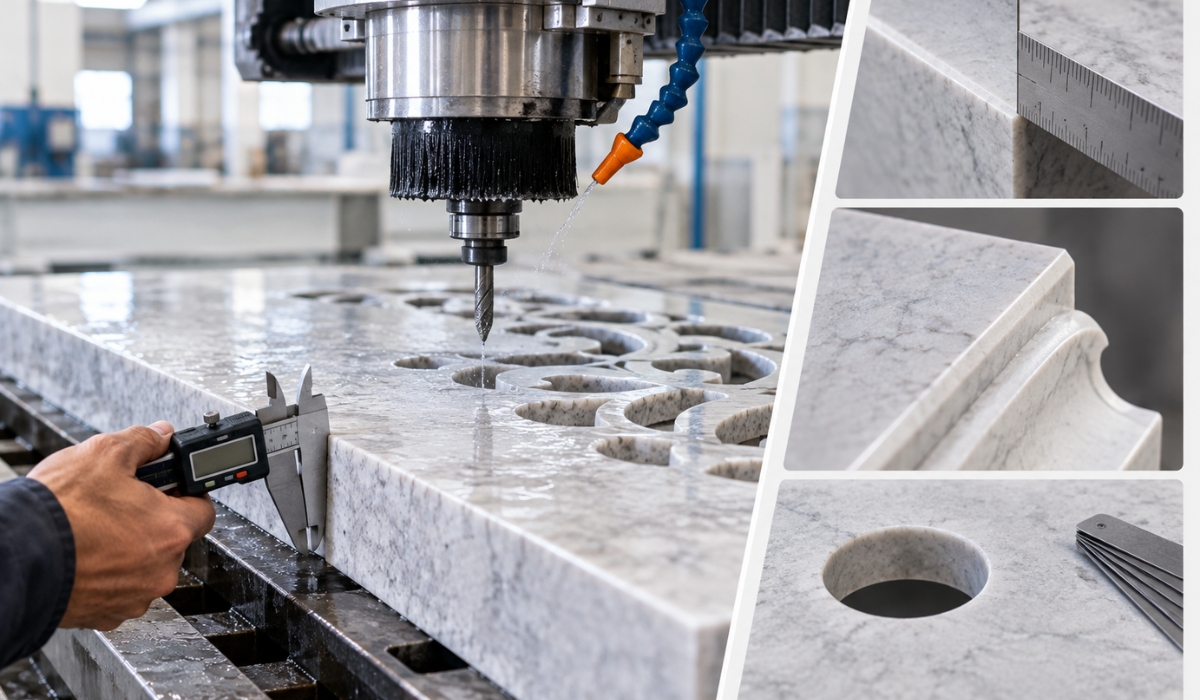
Measurement method: Measuring with a tape measure, caliper, laser system, or precision inspection equipment can produce different levels of measurement resolution. The inspection method should be appropriate for the tolerance being specified.
CNC stone fabrication is used across residential, commercial, architectural, and industrial projects. Common applications include kitchen countertops, bathroom vanities, sink cutouts, cooktop openings, stone wall panels, flooring components, stair elements, furniture tops, monuments, and decorative architectural pieces.
For kitchen countertops, dimensional accuracy is particularly important around walls, cabinets, sinks, appliances, and joints. A small dimensional discrepancy may be manageable where a backsplash or expansion gap is present but can become significant when several components must align precisely.
In commercial and architectural projects, CNC fabrication is often used for repetitive panels or complex geometric components. Consistent tolerances allow multiple pieces to be manufactured from digital drawings and assembled more efficiently.
CNC machining is also useful for curved edges, internal cutouts, drainage grooves, faucet holes, custom profiles, and other features that would be difficult to reproduce consistently using manual fabrication.
For every application, the required tolerance should be determined by the relationship between the stone component and the parts surrounding it.
Start by identifying the most critical dimension in the project. A countertop that meets a wall does not necessarily require the same tolerance as a stone component that must fit precisely around manufactured hardware.
A practical approach is to divide dimensions into categories:
General dimensions: Allow a practical tolerance such as ±1–2 mm when the installation design provides sufficient adjustment.
Critical cutouts: Establish the tolerance from the appliance, sink, hardware, or manufacturer's installation requirements.
Mating components: Use tighter, project-specific tolerances where two fabricated pieces must directly align.
Decorative features: Consider visual alignment, symmetry, and the effect of polishing on the finished dimension.
Installation dimensions: Include appropriate allowances for walls, cabinets, expansion, sealants, joints, and field conditions.
Always work from the latest CAD drawings, site measurements, templates, and manufacturer's specifications. For high-value or complex projects, digital templating or on-site verification can reduce the risk of fabricating from inaccurate dimensions.
It is also important to distinguish machine accuracy from required product tolerance. A machine capable of high positional repeatability does not automatically mean every finished stone dimension can or should be specified to an extremely tight tolerance.
The following ranges can be used as general planning guidance, but the actual project specification should be confirmed with the fabricator and relevant component manufacturer.
|
| ||
|
| ||
|
| ||
|
| ||
|
| ||
|
| ||
|
| ||
|
|
These values are guidelines rather than universal standards. Natural stone fabrication especially requires consideration of material properties and installation conditions. For critical applications, the project drawing should state the exact allowable deviation and measurement method.
Good tolerance control begins before the CNC machine starts cutting. The digital drawing should be reviewed for correct dimensions, offsets, radii, cutout locations, and edge details.
Before production, the stone slab should also be inspected for cracks, inclusions, thickness variations, and other characteristics that could affect machining.
During production, operators can monitor tool condition, cutting parameters, vacuum or clamping stability, and machine performance. Finished components should then be inspected using appropriate measuring equipment.
For critical components, inspection should cover overall dimensions, cutout dimensions, hole locations, thickness, edge profile, and surface condition. Recording inspection results can also help identify recurring machine or tooling problems.
A well-controlled inspection process is especially valuable when producing multiple identical stone pieces because small process errors can otherwise be repeated across the entire production batch.
The right CNC stone fabrication tolerance depends on the component, material, machining process, and installation requirements. As a general planning guideline, ±1 mm to ±2 mm may be appropriate for many non-critical dimensions, while cutouts, mating components, and precision architectural features should have project-specific tolerances. Machine calibration, tooling, programming, stone characteristics, polishing, and measurement methods all influence the final result. The best approach is to define tolerances before fabrication and verify them against the actual installation and component requirements. This helps achieve accurate, consistent stonework while minimizing rework and material waste.
A practical general tolerance can often be around ±1–2 mm, but critical cutouts and mating components should use project-specific tolerances.
CNC machining generally provides greater repeatability for programmed shapes and dimensions, although tooling, calibration, material variation, and finishing still affect final accuracy.
Sink cutout tolerance should be based primarily on the sink manufacturer's required opening dimensions, installation method, and support requirements.
Yes. Thickness variation can affect machining, edge profiles, joints, and installation. The actual slab thickness should be measured and considered during fabrication.
Accuracy can be improved through machine calibration, accurate CAD files, proper templating, stable fixturing, suitable diamond tooling, tool-wear monitoring, and final dimensional inspection.