The cutting method plays an important role in determining the edge quality of metal, stone, glass, and other materials. Different cutting technologies produce different levels of smoothness, accuracy, surface finish, and dimensional precision. Some methods generate heat during cutting, while others use mechanical force or high-pressure water to separate materials. These differences directly affect the final appearance and performance of fabricated components. Choosing the right cutting method helps reduce rough edges, burr formation, material damage, and additional finishing work. For manufacturers, architects, and designers, understanding cutting methods and edge quality is essential for achieving reliable fabrication results.
The quality of a cut edge depends on several factors, including cutting technology, material thickness, machine settings, cutting speed, and material properties. Let's understand how commonly used cutting methods influence the final edge finish.
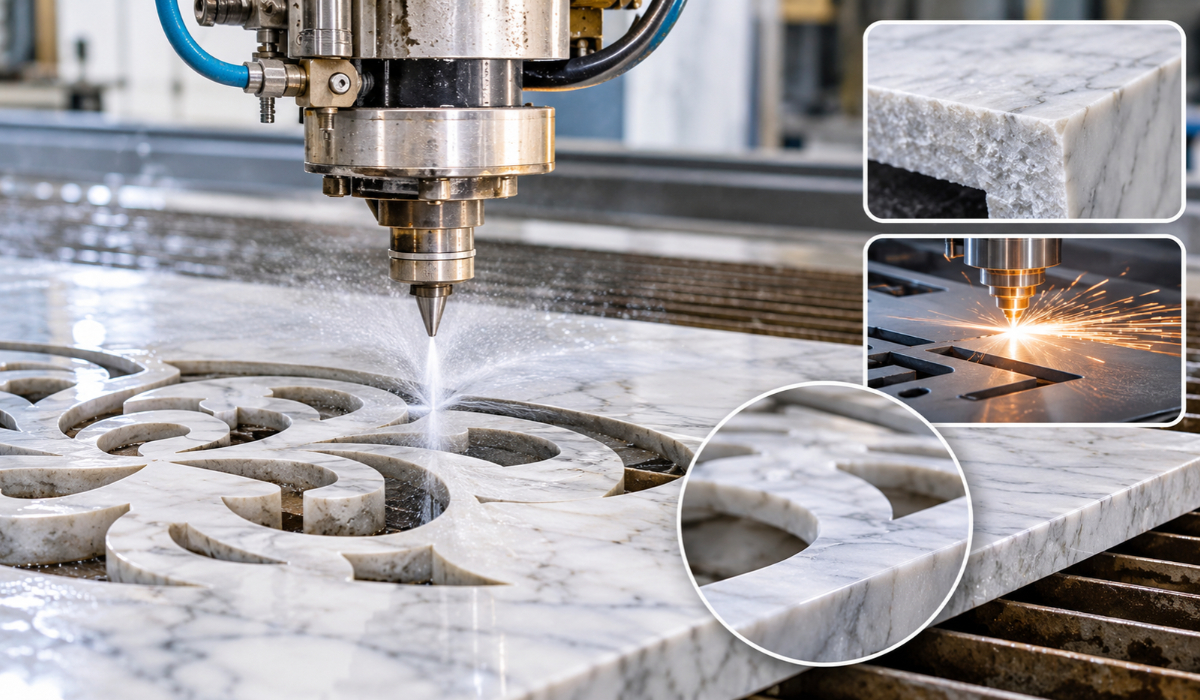
Waterjet cutting uses a high-pressure stream of water, often mixed with abrasive particles, to cut different materials. Since the process does not rely on a heat-based cutting mechanism, it avoids the typical heat-affected zone associated with thermal cutting.
Edge quality advantages:
However, cutting speed, abrasive flow, material thickness, and nozzle condition can influence edge smoothness. Slower cutting speeds and optimised parameters generally help achieve better edge quality.
Laser cutting uses a concentrated beam of light to melt or vaporise material along a programmed cutting path. It is widely used for sheet metal fabrication where accuracy and clean edges are important.
Edge quality advantages:
However, because laser cutting involves heat, some materials may experience heat-affected zones, oxidation, dross, or slight edge discoloration. Proper power, focus, assist gas, and cutting speed settings are important for achieving a clean finish.
Plasma cutting uses an electrically conductive, high-temperature plasma arc to cut metals such as mild steel, stainless steel, and aluminium. It is commonly used in industrial fabrication for medium and thick metal plates.
Edge quality advantages:
However, plasma cutting can produce a heat-affected zone, dross, rougher edges, and angularity depending on machine settings and material thickness. Additional grinding or finishing may be required for applications demanding a smooth edge.
Mechanical cutting involves physical tools such as saw blades, milling cutters, shears, and other machining equipment to separate or shape materials.
Edge quality advantages:
The final edge quality depends on tool sharpness, cutting speed, material hardness, and machine stability. Dull tools can create burrs, rough edges, and unwanted deformation.
Apart from the cutting technology, several additional factors determine the final edge finish.
Different materials respond differently to cutting processes. Stainless steel, aluminium, brass, marble, granite, and glass require different cutting parameters and techniques.
Thicker materials generally require more controlled cutting parameters. Incorrect settings can result in uneven edges, tapering, roughness, or excessive cutting marks.
Cutting speed directly affects edge quality. Excessively high speeds can produce incomplete cuts or rough edges, while unsuitable low speeds can increase heat exposure or create unwanted surface effects depending on the process.
Proper machine alignment, nozzle condition, tool sharpness, and CNC calibration are important for achieving consistent cutting accuracy.
Experienced operators understand how to adjust machine settings according to material type, thickness, and design requirements. This helps improve consistency and minimise cutting defects.
High-quality cutting edges improve the overall performance, appearance, and reliability of fabricated products.
1. Better Appearance: Smooth and clean edges provide a professional finish, especially for decorative metal screens, architectural panels, and stone designs.
2. Improved Dimensional Accuracy: Precise cutting helps components fit correctly during fabrication and installation.
3. Reduced Finishing Work: Good edge quality reduces the need for excessive grinding, polishing, deburring, and additional correction.
4. Better Assembly: Accurate edges and dimensions help different fabricated components fit together more effectively.
5. Consistent Production: Selecting the right cutting method helps manufacturers maintain repeatable quality across multiple components.
Edge quality is important in several residential, commercial, architectural, and industrial applications.
Decorative metal jali panels require accurate cutting and clean edges to maintain intricate patterns and achieve an attractive architectural finish.
Stainless steel fabrication requires controlled edges for equipment panels, brackets, enclosures, and industrial components.
Stone cutting applications such as floor medallions, marble inlays, decorative borders, and wall panels require precise edges to maintain design accuracy.
Glass and ceramic cutting applications require appropriate cutting methods to minimise chipping and maintain the required shape and finish.
Industrial components, machine parts, brackets, and structural elements require accurate cutting dimensions and suitable edge finishing for proper assembly.
Selecting the correct cutting process depends on the material, design complexity, thickness, production requirements, and desired finish.
First, determine whether the material is stainless steel, mild steel, aluminium, brass, marble, granite, glass, or ceramic. Each material requires a suitable cutting technology.
If the application requires minimal heat-related damage, waterjet cutting may be suitable. For precise sheet metal components, laser cutting can be an effective option. Plasma cutting is useful for many heavy metal fabrication applications.
Intricate patterns, curves, decorative shapes, and detailed architectural elements require machines capable of following accurate CNC cutting paths.
Not every cutting process is equally suitable for every thickness. Evaluate machine capacity and cutting parameters before selecting a method.
Work with a professional fabrication company that understands cutting technology, material behaviour, edge finishing, and quality control.
At Stone & Metal, Chennai, we specialise in custom stone and metal fabrication solutions, including CNC waterjet cutting, decorative metalwork, and precision architectural components. Selecting the right fabrication process helps achieve the desired finish for different project requirements.
The cutting method directly influences edge smoothness, accuracy, surface finish, and overall fabrication quality. Waterjet cutting offers heat-free processing, laser cutting provides high precision for suitable sheet metals, plasma cutting supports heavy metal fabrication, and mechanical cutting offers controlled material removal. Understanding these differences helps manufacturers and designers select the right technology for their projects. Choosing the correct cutting process and maintaining proper machine settings ensures better results, reduced finishing work, and reliable fabricated components.
Waterjet and laser cutting can both produce smooth edges when the correct parameters are used. Waterjet cutting is particularly useful when avoiding heat-related changes is important, while laser cutting offers excellent precision for suitable sheet metal applications.
Yes. Waterjet cutting avoids the typical heat-affected zone associated with thermal cutting methods. It can produce accurate edges with minimal thermal distortion, making it suitable for metal, stone, glass, and ceramic applications.
Rough edges can result from incorrect cutting speed, unsuitable machine settings, worn tools, nozzle problems, excessive material thickness, or incorrect process selection. Proper calibration and parameter adjustments help improve edge quality.
Laser cutting generally offers finer precision and cleaner edges on suitable sheet metal thicknesses. Plasma cutting is often preferred for faster processing of thicker conductive metals. The better option depends on material thickness and project requirements.
Abrasive waterjet cutting is an effective choice for intricate marble and granite designs. It supports detailed shapes, decorative patterns, and precision cutting without the typical thermal damage associated with heat-based cutting processes.