Getting an accurate custom fabrication quote starts with providing the right project information. Whether you need a custom metal gate, jail, railing, architectural screen or other fabricated element, the fabricator needs clear details to understand the scope of work.
Providing complete information at the beginning can help reduce assumptions, quotation changes and delays during production.
So, what information should you provide when requesting a custom fabrication quote?
Start by sharing your available drawings or design.
These may include:
A clear drawing helps the fabricator understand the design, dimensions and fabrication requirements.
Provide accurate dimensions of the required fabricated element.
Depending on the project, this may include:
For site-specific projects, verified site measurements can help avoid fabrication and installation issues.
Clearly mention the required material.
For example:
If a specific material grade is required, include that information in the project specification.
For sheet, plate or panel fabrication, mention the required material thickness.
Thickness can affect the material quantity, cutting process, weight and overall fabrication requirements.
If you are unsure about the appropriate thickness, the fabricator can discuss suitable options based on the application.
Mention how many pieces, panels or components are required.
For example:
Quantity helps the fabricator understand the production scope and material requirements.
The required finish should also be specified.
Depending on the project, this could include:
A clear finish specification helps ensure the quotation covers the expected finishing work.
Provide the project location, especially when transportation or installation is required.
The site location can help the fabricator understand:
For projects in and around Chennai, site conditions can also be important when planning exterior metalwork.
Clearly mention whether you need:
This helps avoid confusion when comparing different quotations.
If the project has a specific deadline, mention the expected completion date.
This allows the fabricator to understand the required production schedule and plan accordingly.
A fabrication quote is more accurate when the project scope is clearly defined.
Incomplete information may result in:
Providing drawings, dimensions, material specifications and finishing requirements at the beginning creates a clearer understanding between the client, architect, contractor and fabricator.
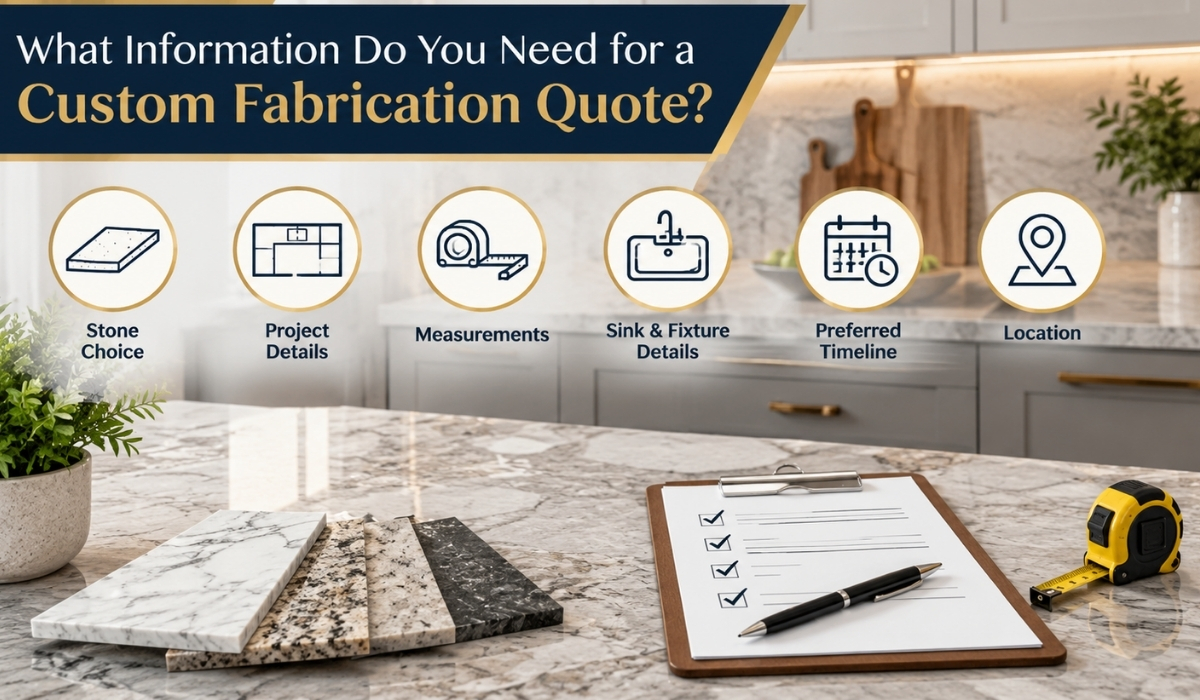
A simple checklist can make the quotation process easier:
✓ Drawing or design
✓ Dimensions
✓ Material and thickness
✓ Quantity
✓ Finish
✓ Site location
✓ Installation requirement
✓ Required timeline
The more complete the information, the easier it is to prepare a project-specific fabrication quote.
To get an accurate custom fabrication quote, provide clear information about the design, dimensions, material, thickness, quantity, finish, site location and installation requirements.
For complex architectural metalwork, sharing detailed drawings and specifications at the beginning can help reduce misunderstandings and make the fabrication process smoother.
Planning a custom fabrication project? Share your drawings and project requirements with Stone & Metal to discuss your fabrication needs and get a project-specific quotation.
You should provide drawings, dimensions, material, thickness, quantity, finish, site location and installation requirements.
Not always. A sketch, reference image or architectural drawing can also help the fabricator understand the initial requirement.
Yes. If a specific material grade is required, include it in the project information.
It can, particularly when transportation, site measurement or installation is required.
Yes. You can discuss the application and design requirements with the fabricator to determine suitable material and thickness options.